
Two days before a wedding, the hallway fills with boxes. Table favours from a small maker, a carton of candle holders, a parcel of ribbon that arrived late, and a bag of guest gifts someone wrapped last night. All of it has to reach the venue, intact and in the right order.
If you're researching wedding limos in Denver or a shuttle for guests, it helps to know early which boxes travel with people and which go ahead separately. This article is about sorting, packing and handing over those boxes so the day's transport carries people, and the parcels arrive where they are needed.
Gather every box in one place first
Wedding deliveries arrive over weeks and end up scattered: some in a garage, some under a bed, some still at a relative's house. Before anything is packed for the day, bring them together on one clear table or a cleared stretch of floor. Open each outer carton and check that the contents match what was ordered, while there is still time to chase a missing item.
This is also the moment to look at the packaging itself. A carton that arrived crushed at one corner may be fine for the trip across town, or it may not. Decide now, not at the venue door.
Denver's weather can change quickly, with dry, sunny spells, sudden storms and snow in the colder months. Boxes that will be carried from a car or coach to a door should be ready for a damp walk, even if the morning looks clear.
Grade the packaging into keep, reuse and dispose
Most wedding goods arrive overpacked. Before repacking anything, sort the materials as you unpack them.
- Keep: sturdy cartons with sound walls and flaps, for the trip to the venue.
- Reuse: clean paper cushioning, tissue and bags, for wrapping fragile pieces.
- Dispose: crushed boxes, torn mailers, loose fill that has spilled everywhere.
Get the dispose pile out of the house straight away. A hallway already full of boxes does not need a second layer of empty ones, and loose fill has a way of turning up in places it should not.
The keep and reuse piles become your packing kit for the day. It is rarely necessary to buy new boxes for a single trip, but whether a reused carton will protect a given item depends on the item. Glass and ceramics need more care than ribbon.
Pack by destination and moment, not by type
The instinct is to put all the candles in one box and all the favours in another. That works in a stock room. On a wedding day, it is more useful to pack by where each box is going and when it is needed.
A box for the ceremony space, a box for the reception tables, a box for the couple's room, a box of things to hand to the venue staff on arrival. Each one holds a mixture of items, but each is opened once, in one place, by one person. That saves someone hunting through three cartons for the table numbers while guests arrive.
| Packing approach | Suits | Watch for |
|---|---|---|
| By item type | Storage before and after the day | Opening several boxes at every stop |
| By destination | Setting up a venue in stages | Fragile and sturdy items in one box |
| By person responsible | Several helpers arriving at different times | A box with no clear owner at the end |
Wrap fragile pieces for carrying, not for storage
Goods that arrived safely by courier were packed for a long journey in a sorting system. The trip to the venue is different: short, but full of lifting, stacking and carrying by people who are dressed up and in a hurry. Repack with that in mind.
Wrap each fragile piece on its own in clean paper or tissue from the reuse pile, then fill the gaps in the box so nothing shifts when it is tilted. Put the heaviest items at the bottom and keep the box to a weight one person can carry comfortably in both arms. Two lighter boxes are easier to manage on a staircase than one heavy one.
Close each box so it can be opened again without a knife. A folded flap or a tied ribbon is easier at a venue than a carton sealed with several layers of tape, and it means the box can be closed again at the end of the night. Whether a reused carton is strong enough for glass or ceramics depends on its condition; if the walls are soft or the corners crushed, move it to the dispose pile and pick a better one.
Mark each box without printing anything
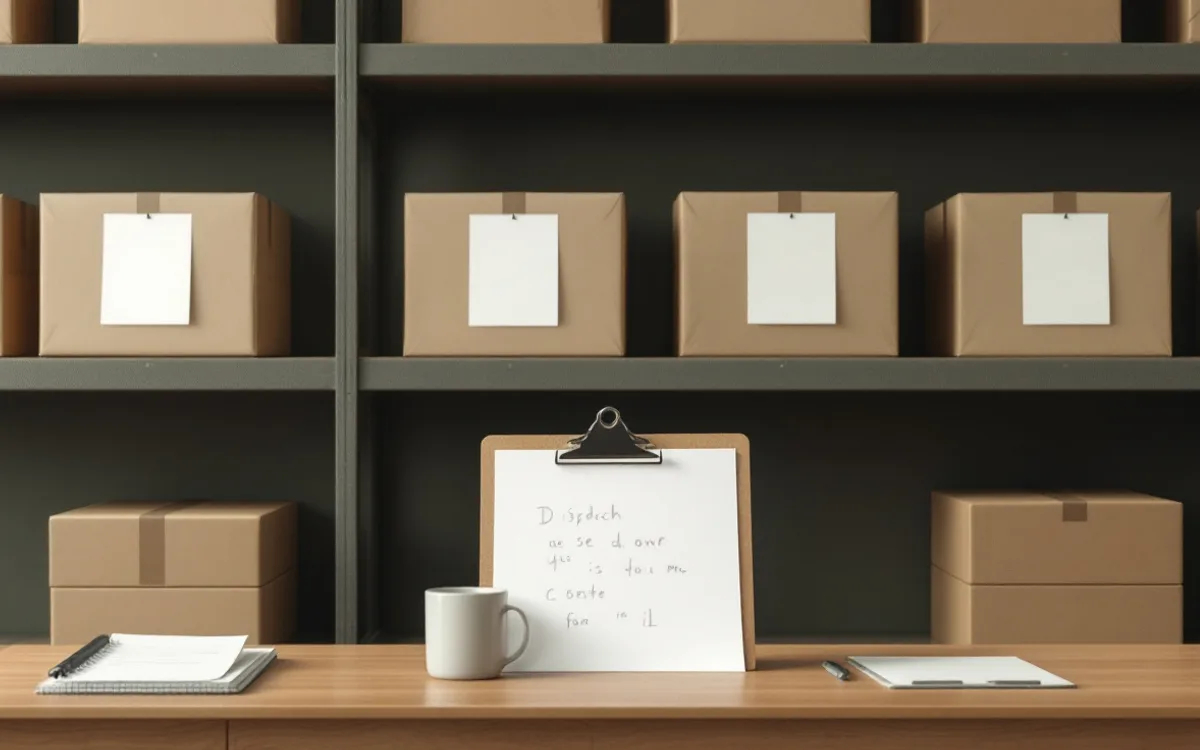
Each box needs to tell the person carrying it where it goes. Plain marking works well: a coloured ribbon tied around each carton, one colour per destination, with a single handwritten card kept by the person coordinating the day. A small numbered list in someone's pocket is easier to read at a busy door than writing on every flap.
Keep the system simple enough that a helper who arrives late can follow it after one sentence of explanation. "Green ribbon goes to the reception tables" is enough.
Avoid packing anything the couple will need during the day, such as rings, documents or medication, in these boxes. Those travel with a named person, not with the cartons.
Bench card
- Gather and open every delivery in one place.
- Grade packaging into keep, reuse and dispose.
- Pack each box for one destination and moment.
- Mark destinations with ribbon, not printed labels.
- Give each box a named person to hand over.
Agree with the transport plan, not around it
The day's transport is built around people: who travels together, from where and when. Boxes can complicate that if nobody has thought about them. Ask the company providing the vehicles what can travel with passengers and where it would sit, and plan the rest separately. Their answer depends on the vehicle and the booking, so check rather than assume.
A common approach is to send most boxes ahead with one person, or deliver them the day before if the venue allows it, so the vehicles carry only the wedding party, their bags and the few items that must stay close. Confirm with the venue when boxes can be dropped and where they will be stored until set-up.
Write the timings into the same short list as the box destinations. The person handing over boxes at the venue should not also be the person who needs to be in a vehicle at the same moment.
Hand over at the door, not on the floor
When boxes arrive at the venue, the risk is that they are left in a corridor for someone to find. Hand each one to the person who will open it, or place it exactly where the list says. If a member of venue staff takes them, show them the ribbon colours and leave a copy of the list.
Check each box on arrival. If something has broken, it is better to know while there is still time to adjust a table than to discover it when guests sit down.
A reset that fits the end of the night
After the last guest leaves, the boxes have a second job. Gifts, leftover favours and decorations need to go home, and the same ribbon system can bring them back. Repack into the sturdiest cartons from the keep pile and hand them to one named person, so they do not travel in three directions.
In the following days, grade the packaging again. Keep a few good cartons for returns or for passing items on, reuse cushioning where it is still clean, and dispose of the rest. The system earns its place when you can describe the problem it avoided: a box of favours that reached the right table, and a hallway clear again within the week.